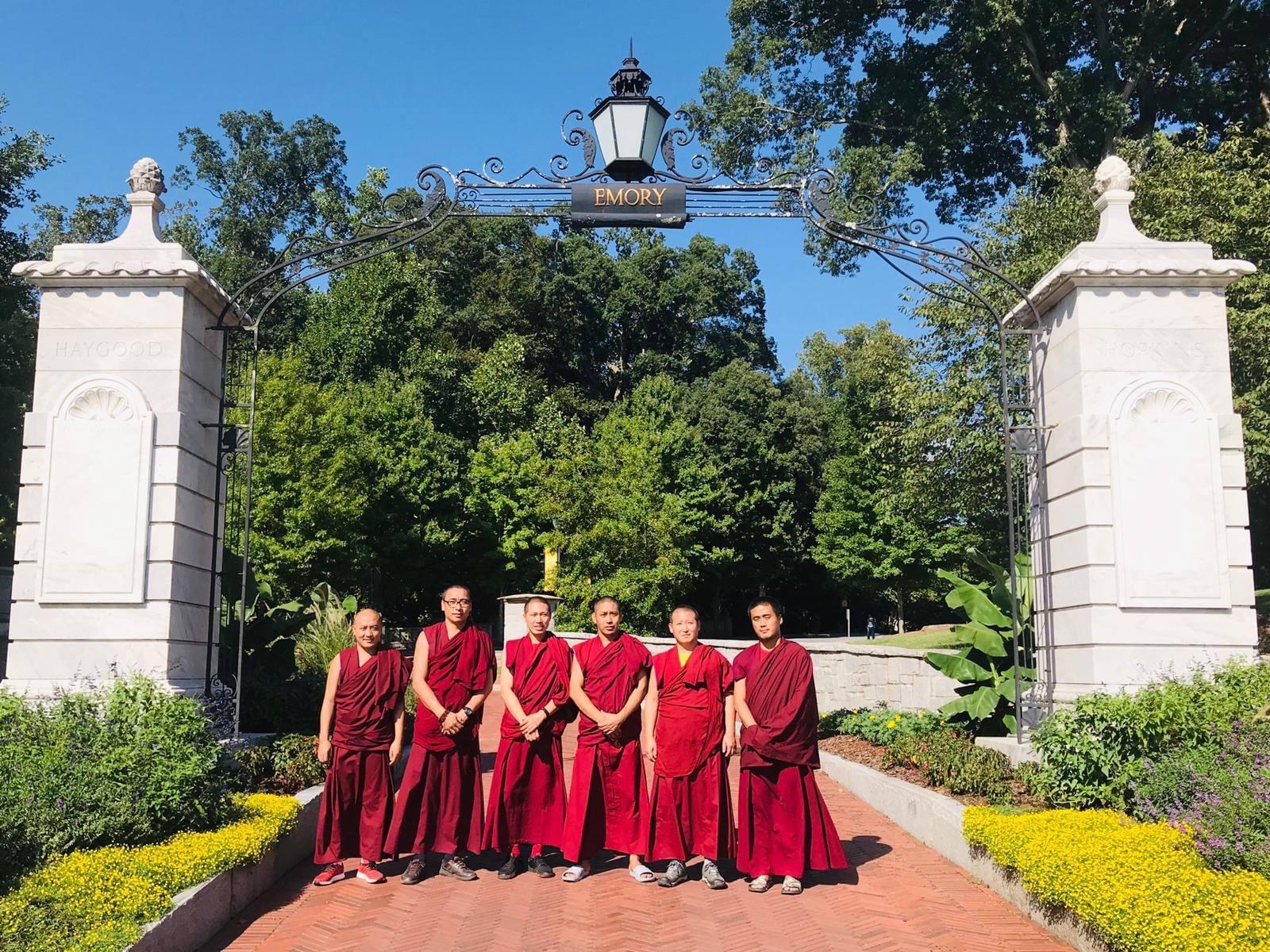
MARCH 2025—SEE Learning® and CBCT® Workshops for ETSI Monastics

Geshe Lobsang Tenzin, Executive Director of the Emory Compassion Center, and Tsondue Samphel, Assistant Director of SEE Learning®, recently facilitated a joint SEE Learning - CBCT® (Cognitively-Based Compassion Training) workshop for Tenzin Gyatso Science Scholars and ETSI graduate science instructors at the Drepung Loseling Meditation and Science Center. This five-day integrated workshop introduced the frameworks and key concepts of both programs, offering participants hands-on activities from SEE Learning lessons and opportunities for reflective practices. The workshop emphasized the integration of scientific inquiry with contemplative practices, fostering critical thinking while building enduring skills such as self-awareness, resilience, compassion, emotional regulation, and ethical discernment. Participants also gained valuable tools to enhance their teaching and personal well-being.
The workshop hosted forty participants, including 22 current and future Tenzin Gyatso Science Scholars and 6 ETSI graduate science instructors, consisting of monks, nuns, and lay Tibetans. These participants explored methods for cultivating basic human values, such as kindness, understanding, humility, and gratitude. They also learned pedagogical techniques grounded in best educational practices.
The interactive sessions provided a platform for deep discussions, reflections, and skill-building exercises, reinforcing the importance of integrating ethics and compassion into contemporary education. The successful completion of this program marks a significant step forward in enhancing the monastic curriculum with modern educational methodologies, while staying rooted in Buddhist values. As these monastic scholars take on increasingly important roles in bridging traditional contemplative insights with modern scientific understanding, training them in these secular educational programs will further deepen their ability to support the integration of these values into education and advance the global culture of compassion that the Emory Compassion Center aspires to foster.
Geshe Lobsang Tenzin, Executive Director of the Emory Compassion Center, and Tsondue Samphel, Assistant Director of SEE Learning®, recently facilitated a joint SEE Learning - CBCT® (Cognitively-Based Compassion Training) workshop for Tenzin Gyatso Science Scholars and ETSI graduate science instructors at the Drepung Loseling Meditation and Science Center. This five-day integrated workshop introduced...
The 7th cohort of Tenzin Gyatso Science Scholars is in the final semester of its two-year program at Emory University. Alongside courses in positive psychology, electromagnetism, biology, and teaching methods for English language learners, the monastic scholars take a directed studies course with Dr. Arri Eisen, veteran ETSI faculty leader and co-author of The Enlightened Gene. He guides them in exploring biological concepts and integrating...
This past November, Emory University’s campus hosted the annual Tibet Week, a collection of enlightening symposiums, conferences, and meetings, while also showcasing traditional Tibetan Arts which date back to Tibet Week’s inauguration in 2001. The cultural week was centered on renewing the partnership made between Emory University and the Drepung Loseling Monastery in 1998, an anniversary reignited by the joint meeting of...
While the Center for Contemplative Science and Compassion-Based Ethics (formerly the Emory-Tibet Partnership), celebrates its 25th anniversary, the Emory-Tibet Science Initiative prepares for its winter programs.
This winter, much like in 2022, ETSI is organizing three major events at the Drepung Loseling Meditation and Science Center in Mundgod, South India.
15th International Conference on Standardizing Scientific Terms...
This September, three monastic students travelled to Evanston, Illinois to participate in a two-month research internship program at Northwestern University. This internship focuses on providing more in-depth training in both theory and methodology of neuroscience research, giving the monastics their first experience of working in an actual state-of-the-art research lab.
This year’s training will be overseen by...
The Emory-Tibet Science Initiative welcomed the 7th Cohort of Tenzin Gyatso Science Scholars to Atlanta this past month. Six students arrived in the United States for the first time, monastics and nuns traveling from India, Tibet, and Nepal. They are: Thuptan Palmo, Rinchen Lhamo Gurung, Dakpa Neaten, Tsering Gelek, Tanzin Mutup and Geshe Tenzin Wangdu.
With the start of the new semester this week, the cohort began...
The Emory-Tibet Science Initiative welcomes the 7th Cohort Tenzin Gyatso Science Scholars, who are coming to Emory University this fall to do a two-year residency program. The six monastic scholars—four monks and two nuns—have been selected from monasteries and nunneries participating in the ETSI science education program to study math, English, and introductory college-level sciences.
The TGSS Program, which started in...
The Emory-Tibet Science Initiative (ETSI) has successfully concluded its summer intensive program, which included the Year 2 Pedagogy Program and the Year 5 Nuns Implementation Phase Program. These programs brought together faculty members from various educational institutions and universities and enthusiastic participants from thirteen monastic academic institutions.
In the Year 2 Pedagogy Program, 11 faculty members from seven institutions...
The collaboration between the Emory Tibet Science Initiative (ETSI) Peer Mentors and the Tenzin Gyatso Science Scholars continues to promote scientific learning and cultural understanding. The diligence exhibited by the sixth cohort and their passion to learn has been evident in the way they continue to ask questions and stay engaged with their course material.
This semester, the scholars are continuing their study of physics and...
Since the addition of science education into the core monastic curriculum of the Tibetan monastic academic centers in 2014, ETSI has been supporting the collaborating monasteries and nunneries in setting up and expanding science labs at their respective institutions. Right from the start, the ETSI understood the necessity of including objective experiments, critical observations and analytic investigation in the monastics’ science...
The Year 2 Sustainability Phase Winter Intensive Program was held at Drepung Loseling Meditation and Science Center, Mundgod, India in December 2022. It consisted of a five-day ETSI Translation Workshop followed by a twelve-day ETSI Research Methodology Training.
The translation workshop focused on cultivating techniques and skills to produce good quality translation and was attended by 59 participants from ten monastic institutions, including...
The annual International Conference on Standardizing Scientific Terms in Tibetan is a key component of the Emory-Tibet Science Initiative's translation work. Since 2009, ETSI has hosted thirteen ICSSTTs with the aim of standardizing scientific words in Tibetan to support its science education program for the Tibetan monastic communities.
The 14th conference was held from November 22–30, 2022, at the Drepung Loseling...
Research training is critical to the Emory-Tibet Science Initiative's (ETSI) Sustainability Phase. The vision is to expose monastic scholars to current neuroscientific research projects and methods, further their understanding of neuroscience, and establish a foundation for them to train others in their respective monastic institutions and initiate research projects and collaborations. The first cohort completed the two-month ETSI Science...
Last week, Emory University hosted its annual 21st Tibet Week at the Michael C. Carlos Museum. Tibet Week is a significant event of the Center for Contemplative Science and Compassion-Based Ethics, formerly known as the Emory-Tibet Partnership, held annually to celebrate the partnership formed between Emory University and the Tibetan world. Aside from sharing various aspects of Tibetan culture, Tibet Week highlights the undertakings of the...
Emory-Tibet Science Initiative (ETSI) is always looking for ways to develop monastic human resources in the field of science education; to strengthen the intellectual and logistical foundation in this field established during the launch (2014-2016) and expansion (2017-2019) phases; to create a new breed of scholars who have proficiency in scientific research and pedagogy and who embody the convergence of Tibetan Buddhism and spirituality with...
As a part of its Sustainability Phase, ETSI is collaborating with Northwestern University to launch a research internship program in mid-September for two months. Three monks (Geshe Lodoe Sangpo from Gaden Jangtse, Geshe Thabkhe from Sera Jey, Ven. Tenzin Legden from Drepung Loseling), one nun (Ven. Lobsang Pelmo from Jangchup Choeling), and the Codirector of Drepung Losel Ling Meditation and Science Center...
The Emory-Tibet Science Initiative (ETSI) recognizes the importance of developing a robust language program to optimize the monastics' learning and understanding of the science curriculum and remove barriers to their future contributions to the international science community. To facilitate the growth of the monastic students’ English language skills, Dr. Jane O’Connor, director of the English Language Learning Program...
If reincarnation existed and there were children who could remember their past lives, what is the memory of a previous life supervenient upon? Is there an underlying structure that carries such memories from one life to the other? What underlying process or system supports the consciousness of someone in a thukdam state—a meditative state that advanced practitioners enter after being declared clinically dead? These...
Following the successful launch of the ETSI Sustainability Phase with the year one winter intensive programs that included the ETSI Research Methodology Training and Translation Workshop, ETSI is currently completing the Year One Summer Pedagogy Program (May 6th– June 15th). Concurrently, after a 2-year suspension due to COVID-19, the ETSI Implementation Phase Year 4 for nuns has resumed with the Summer Intensive Program (May...
The COVID-19 pandemic has deeply impacted education everywhere. The World Bank states that the pandemic “has created the worst crisis to education and learning in a century,” with 94 percent of students out of school worldwide at the peak of school closures.
According to UNICEF, in India, 247 million students in primary- and secondary-schools have been affected by COVID-19 school closures. The Tibetan schools in India and...
ETSI hosted its 13th International Conference on Standardizing Scientific Terms in Tibetan from February 7th to 18th. Eighteen scholars, science teachers, Tibetan medical doctors, and science translators from eleven institutions, including the Terminology Section of the Department of Education of the Central Tibetan Administration, the Science Department of the Library of Tibetan Works and Archives, and the Medical Department of Central...
ETSI launched its Year 1 Sustainability Phase Intensive Program this winter with a 5-day ETSI Translation Training followed by a 12-day Research Methodology Training at Drepung Loseling Meditation and Science Center, Mundgod, India.
The initial portion, the ETSI Translation Training, was held November 30th through December 4th, 2021, and included 60 monastic students. The participants include former Tenzin Gyatso Science Scholars,...
By Eric Zhang, Assistant Director of Engagement
Tenzin Gyatso Science Scholars have been visiting Emory for over 10 years now, and with everyone returning to campus for the semester, they’re now inseparable from the community. Professors and students alike form meaningful friendships and relationships with the Emory Monastics while they continue their science education.
The Emory-Tibet Science Initiative (ETSI) was formed in 2006...
Frontiers in Communication is publishing a special issue on ETSI, entitled “The Emory-Tibet Science Initiative, a Novel Journey in Cross-Cultural Science Education”, guest-edited by a diverse team of ETSI professors: Robin Nusslock, a neuroscientist at Northwestern; Meena Balgopal, a science education expert at Colorado State; and Gillian Hue, a neuroscientist; Joel Zivot, an anesthesiologist; and Arri Eisen, a biologist,...
In December, the Emory-Tibet Science Initiative (ETSI) will offer both an intensive training in research methodology and a science translation workshop as part of its three-year Sustainability Phase Program (2021-2024). A select group of sixty monks and nuns from nine monastic institutions will participate in this hybrid training at Drepung Loseling Meditation and Science Center. Some sessions will be taught remotely, and some by on-site...
ETSI announced the winners of its science essay competition on July 6 to coincide with the birthday of His Holiness the Dalai Lama. The competition, which was held to honor and celebrate His Holiness’ immense contributions to the monastic science education, was hoped to inspire monastic students to think, reflect and write on scientific topics of their choice.
ETSI applauds all the participants for their...
The 6th cohort Tenzin Gyatso Science Scholars (TGSS) recently completed four months of intensive preparatory training in English, science, math, and basic computer skills at the Drepung Loseling Meditation and Science Center (DLMSC). ETSI deeply appreciates DLMSC for offering this training, onsite and in-person, when the monasteries were locked down due to the COVID-19 pandemic. The 6th cohort consists of four monks...
ETSI is hosting a 6-week summer webinar series for its Sustainability Phase students from June 1 to July 9. Taught by faculty from nine academic institutions, the series engages over 60 highly motivated and promising students from 13 Tibetan monasteries and nunneries in physics, biology, neuroscience, and philosophy of science to deepen their understanding of content knowledge cultivated during the implementation phase. The students were...
The 5th cohort of six monastic scholars completed their two-year non-degree program at Emory University and participated in Emory University’s 176th Commencement along with one thousand other graduates. The touchless ceremony was more than just a symbolic gesture for the scholars. It represented an important step toward them taking a more active role in the science education programs at their monasteries even as they prepare to...
The newly selected 6th cohort Tenzin Gyatso Science Scholars (TGSS) began their intensive training in math, science, English, and computer skills at Drepung Losel Ling Meditation and Science Center, South India on March 16. This course is aimed at cultivating foundational knowledge of the selected scholars in preparation for their two-year residency program at Emory University. The 6th cohort, consisting of 4 monks and 3 nuns, will join the...
The qualifying exam to select students for the ETSI’s Sustainability Phase was conducted successfully at three sites—Drepung, Sera, and Gaden on February 5, and 60 plus monastics are being selected. The selected monastics, including former Tenzin Gyatso Science Scholars, will receive intensive training in science pedagogy in the summer and research methodology and design in winter. They will be mentored by the Graduate...
Usually, our cohorts of monastics use the academic breaks to relax and travel around the country. Unfortunately, Cohort 5 has been unable to take advantage of this during the continued pandemic. In order to keep the scholars engaged during the winter break, Dr. Jane O’Connor, ETSI English Faculty Leader, from the English Language Learning Program (ELLP), organized a series of speakers to talk to the monastics about a wide...
From December 7th to 11th, ETSI (Emory-Tibet Science Initiative) hosted the 12th International Conference on Standardizing Scientific Terms in Tibetan (ICSSTT). Held over five days, scholars, science teachers, and science translators of Tibetan origin from India and the US participated in the 2-hour virtual forum.
The ICSSTT was established in 2009 at Emory University to standardize the Tibetan scientific lexicons developed by the ETSI...
ETSI offered a five-session webinar to about 50 science educators from monastic institutions that are core participants of its science programs. This series of orientation sessions aimed to provide an overview of the new sustainability phase programs and allow the science teachers to engage and interact with the ETSI faculty leaders.
The sustainability phase is a critical component of ETSI's mission to bring contemporary science into the core...
When the first cohort of Tenzin Gyatso Science Scholars who came to Emory struggled to keep pace with their classmates ten years ago, some Emory students volunteered to help them. After completing their residency program, the first cohort returned to India carrying newly gained knowledge and experiences. But a wonderful legacy has been created. Since then, this student initiative has evolved and grown into a well-organized body. Michael...
The Tenzin Gyatso Science Scholars, known better as “the Emory monks,” completed their first year of study at Emory University. Although their opportunity to attend in-person class and interact directly with their professors and classmates was curtailed by the pandemic, they all had “a meaningful and productive year” of intellectual growth and remarkable opportunities. Lobsang Dhondup, a scholar from...
In addition to the cancellation of the ETSI summer intensive programs, the COVID-19 pandemic has led to the suspension of the ETSI Winter Research Training and the Translation Workshop planned for December. The decision was made for the safety of all the stakeholders, including ETSI faculty members and staff whose participation would require international travel. The winter research workshop, an essential component of the Sustainability Phase,...
Despite the postponement of ETSI’s summer pedagogy training due to the COVID-19 pandemic, the onsite work of the sustainability phase began with the hiring of well-qualified science instructors at the participating institutions. These highly dedicated young Tibetans with graduate degrees in different areas of science will anchor the monasteries’ science education program and mentor indigenous science teachers. With these...
ETSI is organizing a science writing competition for its monastic students to celebrate His Holiness the Dalai Lama's immense contributions to the monastic science education and to encourage the monastic students to think more deeply about science and write about it in their own language. Please see the Tibetan and English flyers for details. (Links in full article).
Gelek Gyatso, Geshe Tsering Phuntsok, Lekpa Gyatso and other former scholars have been offering online science classes to the monastic students. They are creatively using social media platforms to reach a wider audience.
Monasteries participating in the ETSI science programs have initiated remote learning to continue their science classes. Science teachers, including former Tenzin Gyatso Scholars, at different monastic institutions are experimenting with remote science classes. This has led to creation of much needed educational resources in Tibetan language.
The 5th cohort of Tenzin Gyatso Science Scholars, popularly known as the Emory monks, completed their first year of study at Emory University amidst the pandemic. Emory’s shift to distanced learning in March was a new experience for the scholars. Though challenging at the beginning, this gave them an opportunity to explore virtual classrooms and they had a productive first year at Emory. In the first six weeks of their summer break,...
Due to the COVID-19 pandemic, the Emory-Tibet Science Initiative (ETSI) had to cancel its summer intensive programs at the Tibetan Buddhist monasteries in south India. The 4th year implementation phase program for the nuns and the 1st year sustainability phase program for the monastics—usually organized in the months of May and June—couldn’t take place as usual. ETSI hopes to resume the programs when the travel...
A wonderful short video about the ETSI Graduation event with His Holiness the Dalai Lama at Drepung Monastery:
See the Live Event here:
https://www.dalailama.com/live or https://www.facebook.com/Tibet.Emory/
Read brochure and program events here :
English Tibetan
Dalai Lama invited Emory University to col-laborate with the Library of Tibetan Works and Archives (LTWA) on a comprehensive and sustainable science curriculum—an op-portunity supported by the university. ETSI was founded with the...
Meditation cultivates concentration, empathy, and insight at a neural level.
There is a gamut of recent neuroscientific studies that support the transformative power of mindfulness and compassion meditation. Different types of meditation are being shown to create different changes in the brain. In this entry I will compare different types of meditation and look at the science behind how they...
According to a study announced Thursday, a meditation program that focuses on compassion was found to boost a person's ability to read the facial expressions of others as well as activate regions in the brain that help us be more empathic. "It's an intriguing result, suggesting that a behavioral intervention could enhance a key aspect of empathy," says lead author Jennifer Mascaro of Emory University in the US state of Georgia. "Previous...




 ETSI
ETSI